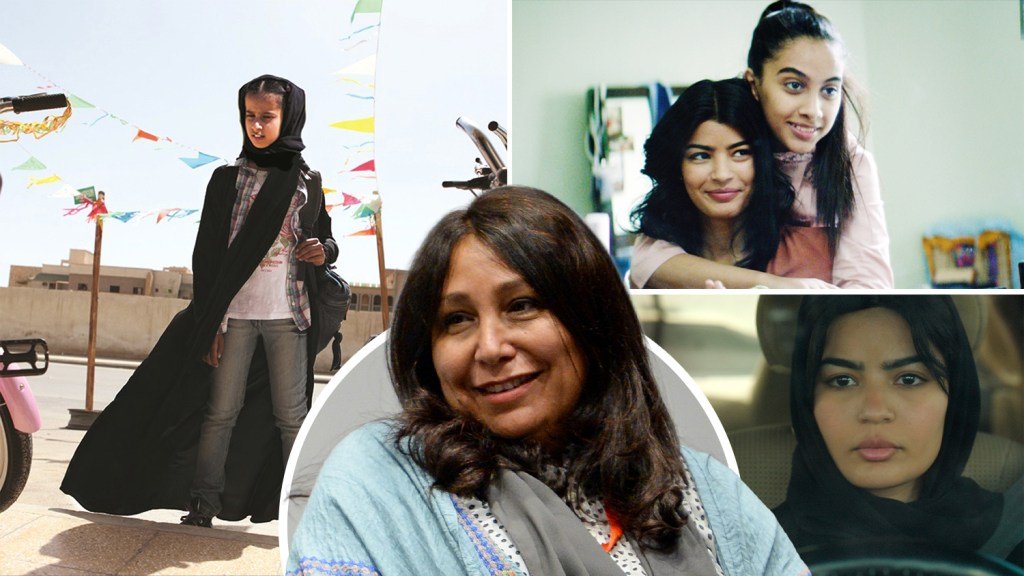
When acclaimed Saudi director Haifaa Al Mansour made her debut film, Wadjda, she was the trailblazing first female from the Kingdom to helm a feature — and she had to communicate with cast and crew via walkie-talkies.
“The country was segregated, so I wasn’t able to be with the actors. That was very limiting for me as a first-time director,” she told Deadline in an interview at the Tribeca Festival earlier this month ahead of a screening of her latest film, Unidentified. The crime thriller premiered at TIFF and Sony Pictures Classics is launching it theatrically today on 90 screens.
Wadjda, released in 2012, is the story of a rebellious 10-year-old Saudi girl who enters a Koran recitation competition at school to win enough money to buy a bicycle, even though it’s forbidden for her to ride one. It premiered at Venice, was nominated for a BAFTA for Best Film Not in the English Language, and was Saudi Arabia’s first Oscar submission for Best Foreign Film. It was also the start of a lose trilogy framed around women “who refuse to be victims, and who are claiming agency.”
In The Perfect Candidate, released in 2019, a hardworking young doctor in a small-town clinic is prevented from flying to Dubai for a conference without a male guardian’s approval and seeks help from a politically connected cousin, inadvertently registering as a candidate for the municipal council. She sees the election as a way to fix the muddy road in front of her clinic, but her campaign slowly garners broader appeal.
“We shot that in 2017, so it was different. We could go into the streets. I remember there was this very conservative person who did not want us to be [there] … And we called the police, and the police checked our permits, and then they took him.” In her string of firsts, The Perfect Candidate was the first feature film to be supported by the newly established national Saudi Film Council, now called the Saudi Film Commission.
Fast forward to Unidentified, the financing was entirely local. “It’s amazing to see how much it’s evolved,” she said. “All our funding came from Saudi Arabia, which is really empowering for local artists.”
The Kingdom lifted a 35-year ban on movie theaters in 2017 and has been pushing aggressively to create a homegrown film industry from zero. The plans are ambitious given myriad challenges, including distance and weather. Most recently, the U.S.-Iran conflict, which saw the latter launch missile and drone strikes on its Gulf neighbors, complicated activity in the region. The two sides signed a memorandum of understanding with an immediate cease fire this week after four months of hostilities.
In May at the Cannes Film Festival, Saudi officials announced plans to hike the country’s incentive for international productions to a hefty 60% rebate for eligible local spending. That will be key, Al Mansour said, “to bring expertise to work in the Kingdom, and, hopefully have younger talent be on sets and get exposed to the art, and also to the politics, of making a film. How a set is run, what it’s all like. There is a tradition that needs to be learned and there is an industry that is emerging and needs to be fed.”
The director, whose credits also include the film Mary Shelley, shorts, documentaries and episodes of TV series from Fear The Walking Dead to Anne Rice’s Mayfair Witches and Bosch: Legacy, said she sees “a lot of younger, female filmmakers” coming up. “It’s nice to see women having a space, especially in a very male dominated society, having a space to tell their stories.”
In Unidentified, the body of a teenage girl is discovered in the desert and Noelle Al Saffan (Mila Al Zahrani) a newly divorced true crime aficionado who recently lost a child of her own, gets obsessively involved. Despite a ticking clock that seemingly guarantees the girl’s senseless death will be discarded as a cold case, Noelle is determined to uncover the truth, using her mind-numbing day job digitizing records at the local police station as a platform. She slowly unravels a mystery entangled within a traditional society in transition, where women are learning to create more space for themselves and to take control of their own destinies. There’s a surprising twist at the end as Noelle’s connection to the case is revealed to be more complex than it seemed.
“I love complicated women,” Mansour said. “Women are never given the story” but often presented “like the angel from heaven. We’re not. We’re normal people. We’re flawed. And I think that if you marginalize a person and push them and take away their options, don’t expect it to be all right.”
All three films unfold in a place where “agency is not given, you have to claim it … Sometimes you claim it in the way Wadjda did, not taking no for an answer. Or like a doctor who’s set to win an election. Or like a person who felt that society had unjustly harmed her and wanted to get back at it.”